


Cash supply and distribution
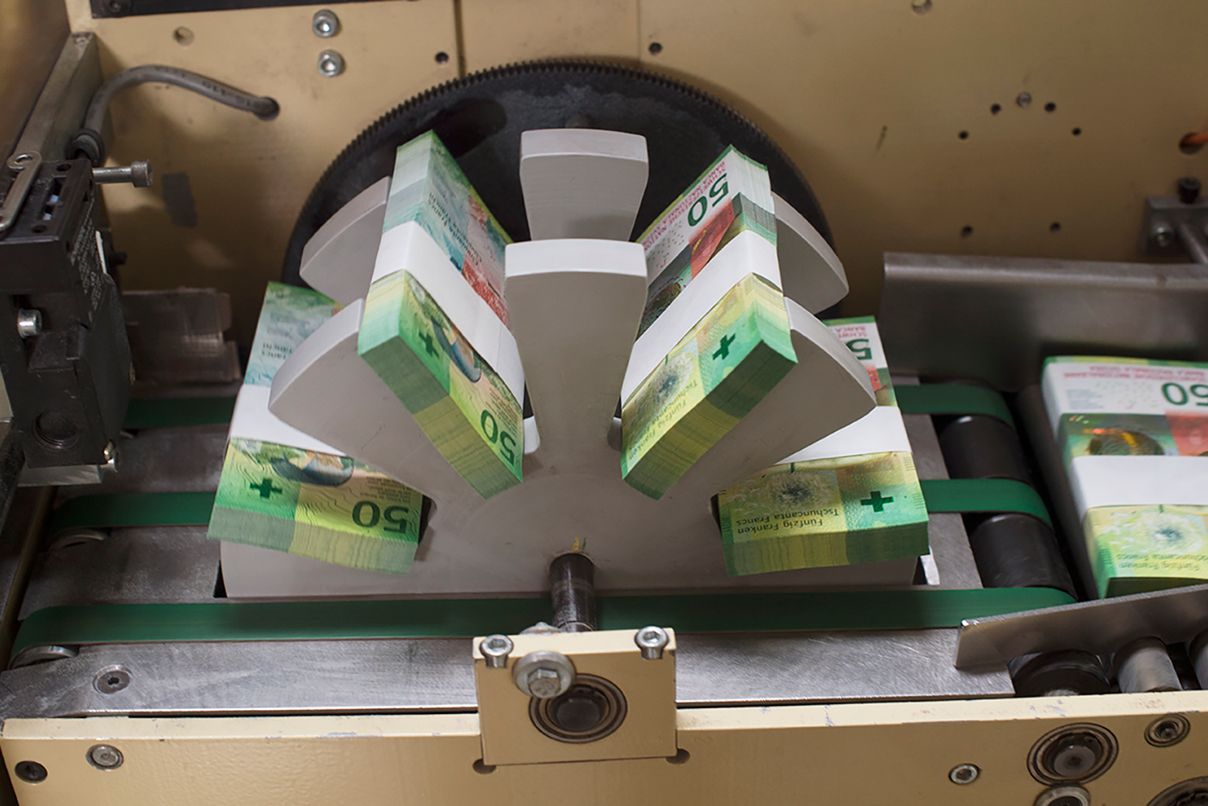

The SNB is entrusted with the note-issuing privilege in Switzerland. Moreover, it is charged with the task of coin distribution. On the following pages you will find everything you need to know about cash in Switzerland.
Mandate and requirements
The Swiss National Bank has the exclusive right to issue banknotes in Switzerland. It supplies the economy with banknotes that meet high standards with respect to quality and security. It is also charged by the Confederation with the task of coin distribution.
Swiss banknotes are traditionally required to meet high standards in terms of security, functionality and graphic design. The SNB aims to meet these standards with the new banknote series, too.
Recall of banknotes from eighth series
The Swiss National Bank recalled its eighth-series banknotes as of 30 April 2021. While the banknotes from the eighth series have lost their status as legal tender, following the amendment to art. 9 para. 3 of the Federal Act on Currency and Payment Instruments (CPIA) which came into force on 1 January 2020, they can be exchanged at the SNB for an unlimited period at their full nominal value.
Banknotes from the eighth series still held by the general public or economic agents, as well as banknotes accepted by the latter, can thus be exchanged at any time and for an unlimited period at the SNB cashier's offices in Berne and Zurich or at an SNB agency at their full nominal value. It is important to note that some agencies apply exchange limits.
Many places also accept banknotes from the eighth series for payments into one's own bank or post office account. Financial institutions must exercise the duty of due diligence in connection with combating money laundering and terrorism financing.
This unlimited exchange period also applies to banknotes from the sixth series. Further information is available in the Instruction sheet on exchanging recalled banknotes. Information on each of the banknote series - in particular their design - can be found at Past banknote series.
Functions and features of cash
Cash has a number of unique features. It can be used at any time, ensures financial inclusion, protects financial privacy and is legal tender.
In payments, both cash and electronic payment methods (e.g. payment cards, payment apps) perform important economic functions. They complement each other. Cash is used both as a means of payment and as a store of value. Despite an overall decline in usage, cash remains the most widely accepted payment method for in-person transactions.
The vast majority of the population (97%) would like to retain the option of paying with cash in the future and being able to choose between cash or electronic payment methods themselves. This freedom of choice, which is also important economically, is further underlined by the unique features of cash.
The majority of companies consider cash to be the most cost-effective payment method.
From an economic perspective, it is important that all desired transactions can be completed easily, securely and cheaply. This seems to pertain in the vast majority of cases today, not least thanks to the fact that cash is always available.
The SNB is convinced that cash, with its unique features, will continue to play an important role as a payment method and store of value in the future. This assessment is underscored by the SNB's decision to develop a new banknote series.
Cash offers a number of unique features which alternative payment methods cannot offer, or cannot offer in an equivalent manner:
- Cash can be used at any time without the need for additional infrastructure or equipment. This is helpful in the event of electronic payment system outages. But cash is also a reliable means of payment in situations where there is no electricity or internet connection.
- Cash makes it possible for the public to access central bank money, which is important for fostering trust in commercial bank book money and thus for the functioning of the monetary system. It ensures that value can be stored and payment processes run independently of banks and financial institutions.
- Cash helps to foster competition in the payments field and has a dampening effect on the fees of cashless payment methods. The majority of companies deem cash to be the most cost-effective method of payment.
- Cash does not leave behind a data footprint during the payment process that can be tracked or analysed by third parties, thus helping to protect financial privacy.
- Cash promotes the financial inclusion of various demographic groups who, for different reasons, are not in a position to use cashless electronic payment methods.
Reproduction of banknotes
The reproduction and imitation of banknotes is prohibited in Switzerland according to art. 243 of the Penal Code if there is a danger of the reproduction being confused with genuine banknotes.
The sole responsibility for interpreting and applying this provision of law is vested in the cantonal criminal prosecution authorities, and the Swiss National Bank therefore has no right of disposition in this respect. In the interests of legal security and equal treatment, the Swiss National Bank has listed - by way of example - in the 'Instruction sheet on the reproduction of banknotes' those reproductions that it does not consider likely to be confused with real banknotes and to which, therefore, the provisions of criminal law do not apply.
For advertising and training purposes, the SNB will supply, on loan, digital images of banknotes with a resolution of 150 dpi with the word 'SPECIMEN' written on them. Applications, together with details of the intended use, should be sent to the following address:
Swiss National Bank
Archives
Börsenstrasse 15
P.O. Box
CH-8022 Zurich


Damaged banknotes
In accordance with art. 8 of the Federal Act on Currency and Payment Instruments, the Swiss National Bank replaces damaged banknotes. In the instruction sheet below, you will find explanations regarding the exchange of damaged banknotes.