In recent years, the SNB has made significant progress in many areas of sustainability, and in parallel has developed its sustainability reporting on a continuous basis. It began publishing an environmental report in 2009. This was replaced in 2018 by the annual Sustainability Report, which also covers social and societal issues.
In the Sustainability Report 2025, as in the two previous years, the SNB provides information on non-financial matters within the meaning of the provisions of the Swiss Code of Obligations. This includes environmental, social, employee and human rights matters, as well as efforts to combat corruption.
Key points
- Through its monetary policy, the SNB makes a significant contribution to the sustainable development of Switzerland. Price stability is a prerequisite for economic progress and prosperity, and protects the purchasing power of wages, pensions and savings. The SNB thus also contributes to social cohesion.
- SNB employees live by the standards and values enshrined in the Charter and Code of Conduct, so that the SNB is seen as an institution that can be trusted without reservation. The SNB also attaches importance to its suppliers’ compliance with social and environmental standards.
- The SNB takes account of Switzerland’s fundamental standards and values in its investment policy. It does not invest in shares and bonds of companies whose products or production processes grossly violate values that are broadly accepted at a societal level.
- The SNB disseminates its economic knowledge in society. Its engagement includes an educational programme for Swiss upper secondary schools, the promotion of economic literacy through lectures and, beginning in April 2026, a visitor centre. It also participates in academic dialogue by presenting research results in publications and at conferences.
- The SNB is an attractive and responsible employer. Thanks to its unique performance mandate, it gives its employees the opportunity to work on tasks of great importance to Switzerland.
- In line with its statutory mandate, the SNB takes into account possible consequences of climate change and climate policy for monetary policy, financial stability and the management of currency reserves. To reduce its operational greenhouse gas (GHG) emissions to net zero by 2050 at the latest, the SNB is implementing a transition plan.
How the SNB conducts research and disseminates knowledge
To perform its tasks, the SNB carries out in-house analysis and research, and makes part of this available to the public. It also places great emphasis on economic literacy among the general public. Its engagement includes public speeches, a series of lectures under the banner of the Karl Brunner Distinguished Lecture, an educational offering for Swiss upper secondary schools known as Iconomix and, beginning in April 2026, the operation of a visitor centre in Berne. It also publishes SNB Economic Notes, short contributions based on academic research on subjects that are related to the SNB’s mandate.
Research
To perform its tasks, the SNB conducts research, making its findings known in academic publications as well as at conferences. In so doing, it facilitates the dissemination of specialist economic knowledge. The Study Center Gerzensee serves the same purpose. In 2025, the SNB held 5 academic conferences and conducted 69 seminars. In 2025, the focus of research was on the use of novel data sources and methods to develop new economic indicators for Switzerland, for example through the analysis of granular data or the evaluation of texts (cf. Research Report under ‘Additional content’).
Educational offering for schools
Since 2007, the SNB has been promoting the economic literacy of young adults by providing instructors with free teaching material through its web platform Iconomix. Its core offering comprises teaching units available in various Swiss national languages as well as in English. The thematic focus of Iconomix is on the fields of economics and personal finance, with a special emphasis on current issues and challenges for society. In 2025, this offering was used at 83% of public upper secondary schools in Switzerland. The programme is supplemented by practice-oriented continuing education events for teachers. www.iconomix.ch
"With Iconomix, the SNB is strengthening young people’s understanding of economics, because education fosters responsible behaviour in the future."
Rosmarie Schlup, Alternate Member of the Governing Board of the Swiss National Bank


Asset management
When managing securities of private sector issuers, the SNB also takes non-financial aspects into consideration. It respects Switzerland’s fundamental standards and values in its investment policy and does not invest in shares and bonds of companies whose products or production processes grossly violate values that are broadly accepted at a societal level. The process of exercising voting rights relating to shares is another non-financial aspect of managing securities issued by private sector companies.
Exercise of voting rights
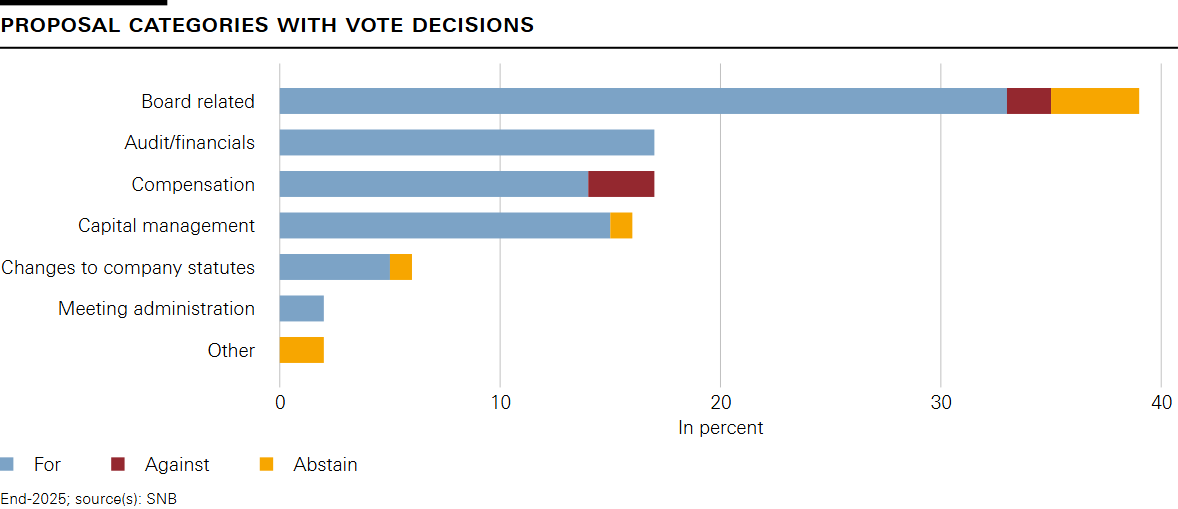
The process of exercising voting rights relating to shares is another non-financial aspect of managing securities issued by private sector companies. Here, the SNB restricts itself to issues of corporate governance and focuses on mid-cap and large-cap companies in Europe, working with external service providers to this end. The SNB does not exercise its voting rights in the US. Votes are cast based on the SNB’s guidelines for exercising voting rights, available on its website. In 2025, the SNB voted on a total of 4,740 agenda items at 266 shareholder meetings. Most of the votes were cast on board-related matters, particularly the election of directors and supervisory boards, as well as the ratification of board acts (cf. chart 1 under ‘Downloads’).
Exclusion criteria
The SNB does not invest in shares and bonds issued by companies that systematically violate fundamental human rights, systematically cause severe environmental damage, or are involved in the production of internationally condemned weapons. In accordance with international agreements, condemned weapons include biological and chemical weapons, cluster munitions and anti-personnel mines. Companies involved in the production of nuclear weapons for countries that are not among the legitimate nuclear-weapon states defined under the United Nations Treaty on the Non‑Proliferation of Nuclear Weapons are also excluded. Companies are considered to systematically cause severe environmental damage if their production operations, for example, systematically pollute waterways or the countryside, or seriously damage biodiversity, or if their business model is primarily based on coal mining for energy production.


Operational climate strategy and transition plan
Based on its climate strategy, the SNB has developed a transition plan showing how operational greenhouse gas (GHG) emissions can be systematically reduced to net zero. It has set itself the target of reducing such emissions from direct emission sources and from the use of energy by at least 50% by 2030 (reference year 2017), and achieving net zero by 2050 at the latest. For the SNB, a significant source of indirect GHG emissions is air travel. These emissions are to be reduced by at least 50% by 2030 versus the 2017 reference year.
Operational climate strategy
The SNB has been implementing environmental initiatives since as far back as 1989. In the first few years, these measures were primarily geared to improving the energy performance of its buildings. Since the introduction of systematic environmental management in 1996, it has been possible to comprehensively report on the environmental impact of the SNB’s operational activities and identify areas for improvement. The SNB’s climate strategy consists of four levels. The idea is that GHG emissions should first be avoided, then reduced, and then replaced with the use of low-emission energy sources. Fourthly, the SNB supports climate protection projects covering the extent of its unavoidable emissions.
Transition plan measures
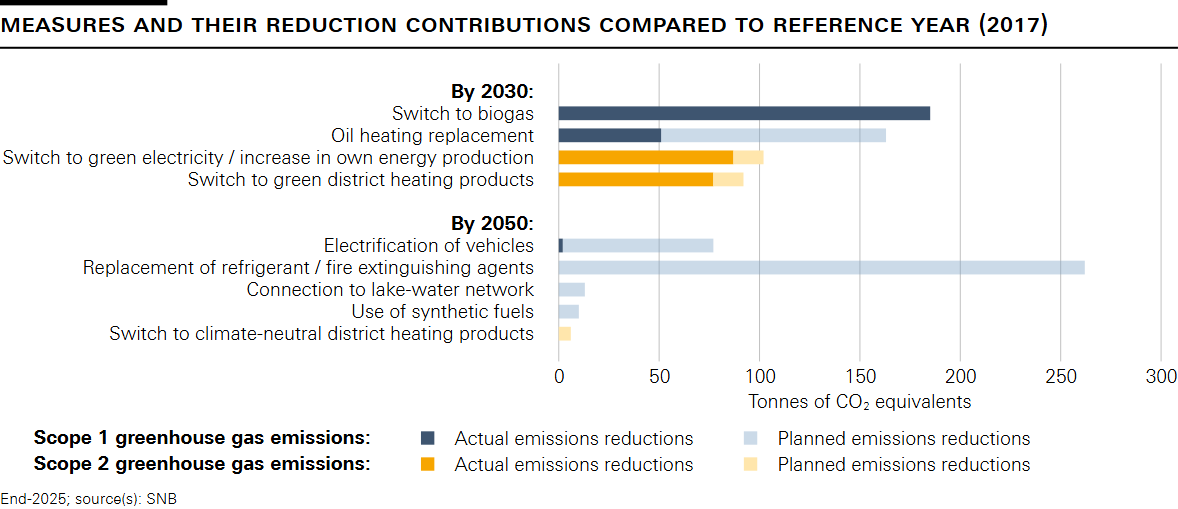
The targets of the transition plan are to be achieved through a combination of various measures focusing on substitution and technical improvements with significant reductions in emissions (cf. chart 2 under ‘Downloads’). Measures in the period up to 2030 include replacing oil heating systems and substituting gas heating with biogas. Longer-term plans envisage, for example, the complete replacement of climate-damaging refrigerants and the connection of more buildings to the lake-water network. Important steps taken in the year under review were improving the energy efficiency within buildings, deploying low-emission vehicles, and putting a photovoltaic system into operation.
Trend in greenhouse gas emissions
The direct greenhouse gas (GHG) emissions and those indirectly caused by the use of energy have fallen 72.5% since the reference year 2017. Particularly responsible for this decrease are substitution measures implemented, for example the replacement of oil heating systems, the substitution of natural gas heating with biogas, and the purchase of renewable electricity. Energy consumption has also been reduced by 10.6% thanks to efficiency improvements. Refrigerant agent losses remain an important source of direct GHG emissions, highlighting the importance of measures to replace such agents in the long term. Emissions from air travel declined in 2025.